
Kempton Park Racing Results Today: All-Weather and Jumps
 Available in US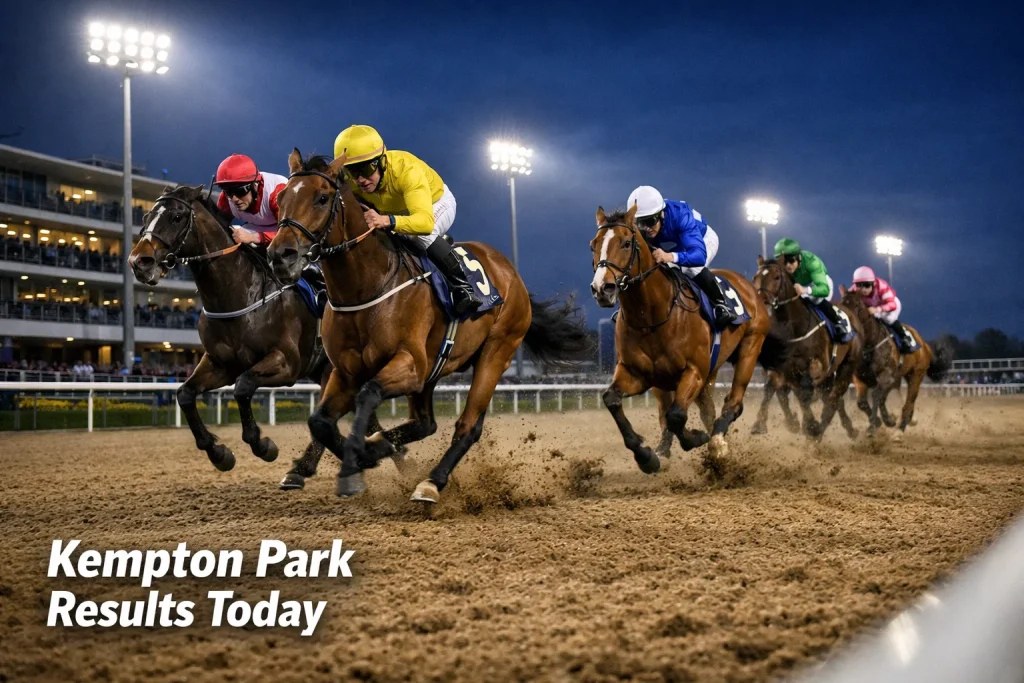
Kempton Park racing results reflect one of British racing's most versatile venues. This Surrey track operates year-round, staging floodlit all-weather fixtures on its Polytrack surface alongside winter jump racing over conventional fences. Results from Kempton matter across both codes, with the course producing reliable form that travels well to other tracks.
The track's dual-purpose nature means Kempton results appear throughout the racing calendar. As RCA Chief Executive David Armstrong noted when discussing racing's diverse offerings, British racing represents a unique sport that combines heritage venues with modern facilities—Kempton exemplifies this balance perfectly. The 1,410 annual fixtures across British racing include regular Kempton meetings that fill gaps in the calendar when weather closes turf tracks elsewhere.
For punters, understanding Kempton means recognising two distinct identities. The all-weather track demands specific abilities—horses who act on the Polytrack surface and handle the tight, right-handed configuration. The jumps course, with its flat terrain and good ground, produces different form patterns entirely. Boxing Day and beyond, Kempton delivers results that shape both codes.
Kempton Park Dual-Purpose Track: All-Weather and Jumps Results
Kempton's dual-purpose designation describes a track that genuinely operates in two modes. The all-weather Polytrack circuit runs throughout the year, primarily hosting evening fixtures under floodlights. The jumps course, built on the same land but following a different configuration, stages National Hunt racing during the winter months. Results from each discipline require separate interpretation—form on the flat all-weather circuit rarely crosses over to jump racing, and vice versa.
The all-weather operation dominates the fixture list numerically. Kempton stages regular evening cards that draw runners from yards across the South of England, providing competitive racing when daylight hours restrict afternoon turf action. Results from these meetings contribute to the 26,778 flat runs recorded by the BHA in the first half of 2024 alone, demonstrating the volume of racing that all-weather tracks now provide.
The jumps operation, though less frequent, produces higher-profile results. The winter programme builds toward the Christmas period when Kempton becomes the focus of National Hunt attention. Quality fields assemble for graded contests, and results from these fixtures carry weight throughout the jump season.
Understanding which Kempton you're analysing matters for form study. All-weather specialists may have dozens of runs at the track; jump horses might appear once or twice a season. The form profiles differ entirely, and results need contextualising accordingly.
All-Weather Racing at Kempton
Kempton's all-weather track operates as a right-handed, triangular circuit just over a mile in circumference. The sharp bends and relatively tight turns place a premium on agility over raw galloping ability. Results consistently favour horses who break well and race handily—those who need time to find their stride often find positions compromised by the quick turns.
The floodlit fixtures create their own atmosphere. Racing under lights on winter evenings draws a specific crowd, and the betting markets behave differently to afternoon turf racing. Results from these meetings attract attention from punters who specialise in all-weather form, a distinct subset of the racing audience who study surface preferences and track configurations obsessively.
Field sizes on Kempton's all-weather tend toward the competitive. Handicaps regularly fill, and results often produce close finishes that require photo analysis. The tight layout means traffic problems occur frequently; horses can find themselves boxed in with nowhere to go as the field turns into the short straight. Results sometimes reflect racing luck as much as ability.
The draw plays a significant role in Kempton all-weather results, particularly over sprint distances. Lower draws generally hold an advantage, though the extent varies with field size and pace dynamics. Punters studying results should note draw positions alongside finishing margins to understand whether a horse achieved its result through merit or circumstance.
The King George VI Chase: Boxing Day Tradition
The King George VI Chase defines Kempton's jump racing identity. Run on Boxing Day over three miles on the conventional fences course, this Grade 1 contest attracts the best staying chasers in training. Results from the King George carry enormous significance for the remainder of the jump season, often identifying the principal contenders for the Cheltenham Gold Cup three months later.
The race demands a specific skill set. Kempton's flat terrain suits galloping types who jump efficiently at speed rather than those who rely on stamina to grind down opponents on testing ground. Results show that previous King George winners have often been different in profile to Gold Cup winners—though some exceptional horses have won both, the specialist often beats the stayer here.
The Boxing Day timing adds commercial significance to results. Television audiences peak over Christmas, and the King George represents jump racing's showpiece moment outside the Cheltenham Festival. Results receive scrutiny from casual viewers who might not follow racing regularly, making the race a gateway to wider audience engagement with National Hunt racing.
Historical King George results read as a roll call of jumping greats. Desert Orchid's four victories defined an era; Kauto Star's record five wins cemented legendary status. Modern results continue adding to this heritage, each December identifying the current generation's champion staying chaser. The supporting card on Boxing Day builds toward the feature, with quality races producing form that informs analysis through the winter.
For punters, King George results demand respect throughout the season. Horses who win or place in this Grade 1 have proven themselves at the highest level under conditions that suit athletic, accurate jumpers. That form holds relevance whenever those horses reappear, particularly at other flat tracks where their galloping style translates effectively.
Polytrack: Understanding the Surface
Polytrack consists of a mixture of silica sand, synthetic fibres, and recycled materials bound together to create a consistent racing surface. Kempton's installation provides year-round racing regardless of weather conditions—the surface drains effectively and rarely freezes, allowing fixtures to proceed when turf tracks face abandonment.
Results on Polytrack differ from turf form in predictable ways. The surface plays fast in all conditions, favouring horses with tactical speed rather than pure stamina. Times are generally quicker than equivalent turf races, and horses who need give in the ground to show their best rarely reproduce their form here.
Some horses develop strong Polytrack preferences. Results reveal runners who consistently outperform on synthetic surfaces compared to their turf efforts. Identifying these specialists offers betting opportunities, particularly when they reappear at Kempton after less successful turf campaigns.
The surface condition remains relatively constant compared to turf going, which changes with weather. Kempton's Polytrack is described as standard in most conditions, occasionally moving to slow after extended dry spells or when maintenance affects the surface texture. Results rarely show the dramatic form reversals that going changes produce on turf.
Fixture Schedule and Key Dates
Kempton's fixture list spans the entire calendar year, though the character of meetings varies by season. Evening all-weather fixtures dominate from autumn through spring when darkness restricts afternoon racing elsewhere. Summer sees fewer Kempton cards as the turf programme expands and daylight extends.
Key dates centre on the Christmas period. The Boxing Day meeting featuring the King George VI Chase represents the pinnacle of the jump calendar at this venue. Supporting fixtures in the days around Christmas provide competitive racing that attracts quality fields looking to take advantage of the festive prize money.
The all-weather programme includes regular competitive handicaps that attract solid fields. Results from these fixtures provide consistent betting opportunities for punters who specialise in synthetic surface racing. The evening timing suits those who prefer to study form after work before betting in the final hour before post time.
Jump fixtures beyond Christmas continue through February, with Kempton staging graded races that inform thinking for the Cheltenham Festival. Results from these meetings identify horses in form and ready to tackle championship events. The flat terrain means conditions rarely become testing, providing reliable ground for horses being aimed at March targets.
Kempton's accessibility from London makes it a popular venue for race day attendance. Results from well-attended meetings carry an atmosphere that translates through television coverage, contributing to the track's profile within British racing's diverse portfolio of venues.
