
Ascot Racing Results Today: Britain's Premier Racecourse
Best Horse Racing Betting Sites – Bet on Horse Racing in 2026
Loading...
Ascot racing results command attention across the racing world. The course in Berkshire holds a status unmatched in British flat racing—Royal patronage since 1711, a fixture list packed with Group 1 contests, and a grandstand that frames some of the sport’s most memorable finishes. Results from this track appear in bloodstock catalogues and form guides worldwide because they mean something.
The prestige attracts quality. With 9,561 flat horses currently in training across Britain, the best of them find their way to Ascot’s major meetings. Royal Ascot attendance rose 2.7% in 2024 according to the Racecourse Association, reflecting the course’s enduring appeal to both serious punters and those who appreciate racing as spectacle. The combination of elite competition and packed stands creates an atmosphere where results carry additional significance.
Beyond the June Royal Meeting, Ascot stages important racing from April through October and maintains a proper jump programme through the winter. The course’s versatility—hosting everything from Group 1 championship races to valuable handicaps and National Hunt contests—means that understanding Ascot results requires appreciating how the track configuration affects different types of races.
Course Profile: Round and Straight
Ascot operates two distinct courses that produce fundamentally different races. The round course, a right-handed triangular track of approximately a mile and six furlongs, hosts middle-distance and staying races. Its sweeping bends and long straight reward horses who travel smoothly and finish strongly—hold-up horses who pick off rivals in the closing stages frequently prosper here.
The straight course runs uphill for the entire five furlongs and stages some of the most competitive sprint racing in Britain. The draw on this course can prove decisive; in large fields, low numbers often hold an advantage along the stands rail. Results from straight-course handicaps demand careful interpretation because positional luck can trump pure ability.
Both configurations share Ascot’s famous rising finish. The climb from the furlong pole to the winning post separates horses on stamina, and results frequently show rivals catching fading leaders in the final hundred yards. When assessing Ascot form, note how horses finished their races—those who stayed on strongly up the hill have answered a genuine test of stamina.
The ground at Ascot varies seasonally but the course generally provides fair racing surfaces. The going tends toward good during summer, though significant rainfall can produce testing conditions even in June. Results on softer ground identify horses who act when the mud is flying, information that proves valuable come autumn.
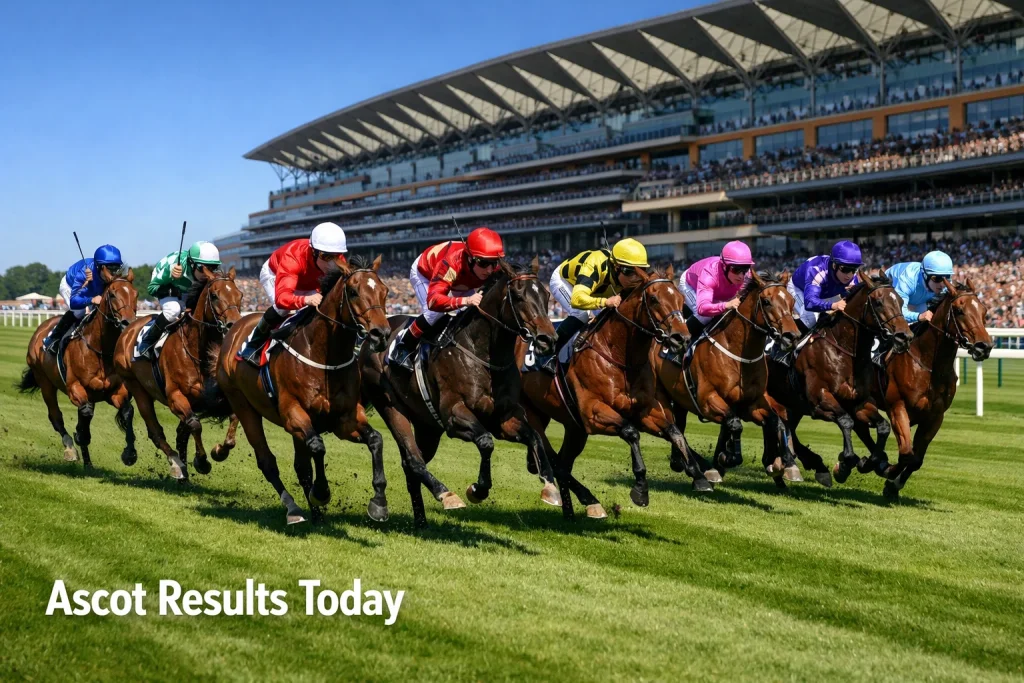
Sightlines at Ascot are excellent, and the modern grandstand development ensures that racegoers can follow the action clearly throughout. This matters for anyone watching results unfold live—the visual clarity means that what appears to happen in the race is genuinely what occurred.
Royal Ascot: The June Showcase
The Royal Meeting in June represents the pinnacle of British flat racing. Five days of championship-calibre racing, the Royal Procession, and an atmosphere unlike anything else in the calendar combine to make these results the most closely followed of the year. Eight Group 1 races headline the programme, from the Queen Anne Stakes on Tuesday to the Diamond Jubilee Sprint on Saturday.
Results from Royal Ascot shape breeding decisions worth millions. A horse winning a Group 1 here immediately enhances their residual value; for colts, Royal Ascot victories translate directly into stud fees. The commercial stakes ensure that trainers bring their best horses fully prepared, which in turn guarantees that results reflect genuine championship form.
The week’s most valuable handicaps attract runners from across Europe. The Royal Hunt Cup, Wokingham Stakes, and Britannia Stakes regularly see fields exceeding thirty runners, with form students poring over every conceivable angle. Results from these massive-field handicaps can prove harder to assess than Group races simply because so many factors—draw, pace, traffic—influence finishing positions.
International competition has intensified in recent years. Results increasingly feature horses from Ireland, France, America, Australia, and Japan—the Royal Meeting has become a global destination for top-class racehorses. This international dimension adds complexity to form analysis but also ensures that winners have beaten the best available opposition.
Weather during the June meeting affects results significantly. A wet Royal Ascot produces different winners than a week of sunshine and quick ground. Tracking ground conditions across the five days helps explain why certain horses outperformed expectations while others disappointed.
For punters, Royal Ascot results offer a concentrated burst of high-quality information. Horses who run well here but finish out of the first three often progress to win subsequently at other tracks. The form tends to work out strongly precisely because the quality of opposition is so high.
Flat Racing Throughout the Season
Ascot’s flat programme extends well beyond the Royal Meeting. The course stages valuable racing from late April through October, with several meetings producing results that matter to serious form students. The Victoria Cup in May traditionally attracts a competitive field of milers, while the summer fixtures offer trials for autumn targets including British Champions Day.
QIPCO British Champions Day in October closes the flat season with a festival of championship racing. Six Group 1 races in a single afternoon create results that determine end-of-season honours and inform breeding decisions for the following year. The Champion Stakes, the meeting’s centrepiece, brings together the best middle-distance performers in Europe for a defining contest.
Results from British Champions Day carry particular weight because horses are running at the end of their seasons. Those who win here have demonstrated durability across a campaign, a trait that breeders value highly. The meeting also provides information about how horses handle Ascot’s unique configuration, useful for projecting their chances if they return the following year.
The July Meeting offers a different proposition—Listed races and valuable handicaps in midsummer conditions. Results from this fixture often identify progressive horses who go on to better things in the autumn. The relaxed atmosphere belies the competitive nature of racing across the card.
The Shergar Cup, an annual jockeys’ competition, showcases international riders competing in teams. Results from this fixture need contextualising—the team format means jockeys ride horses they might not choose naturally, which can produce unexpected outcomes.
Jump Racing at Ascot
Ascot transforms into a National Hunt venue from November through February, and the quality of its jump racing often surprises those who associate the course purely with summer glamour. The track configuration translates well to jumps—the right-handed turns and testing uphill finish produce results that reflect stamina and jumping ability.
The Clarence House Chase in January represents Ascot’s flagship jumps contest, a Grade 1 two-mile chase that frequently attracts Champion Chase contenders. Results from this race indicate which horses handle the track’s demands at championship pace, useful information for Cheltenham projections the following month.
The Ascot Chase, run over an extended two and a half miles in February, provides another significant piece of jump-racing form. The race has produced notable winners over the years, and results here inform thinking about the Ryanair Chase and similar targets.
Jump racing at Ascot benefits from the course’s excellent facilities. The fences are well-maintained and ride fairly, while the ground management ensures safe racing surfaces even in midwinter. Results from these fixtures can be taken at face value—the course asks proper questions of horses without springing unfair surprises.
Fixture Calendar and Key Dates
Ascot’s racing calendar runs from late April to late February the following year, with the course dark only during March and early April. The fixture list is published annually by the BHA, with key dates remaining largely consistent year to year. Planning around Ascot’s major meetings allows punters to track target horses through their preparations.
The sequence typically begins with the Victoria Cup meeting in May, progresses through Royal Ascot in June, the Summer Mile card in July, and continues with autumn fixtures building toward British Champions Day in October. The jump season then provides racing through to February’s conclusion.
Results from consecutive Ascot meetings can reveal progression in individual horses. A runner who improves from the Victoria Cup to Royal Ascot, for example, demonstrates the kind of upward trajectory that justifies market support. Tracking this progression requires attention to the fixture calendar and advance planning.
Weather patterns affect Ascot’s fixture delivery less than some courses due to excellent drainage and ground management. Abandonments are rare, and results from scheduled meetings can generally be expected to occur as planned. This reliability helps punters who like to plan their racing interest in advance.
The course publishes race day details including going reports and non-runner information through official channels. Accessing this information before racing ensures that results can be properly contextualised when they arrive. For a course that generates so much significant form, attention to detail in preparation pays dividends.