
All-Weather Racing Results UK: Live AW Track Updates
 Available in US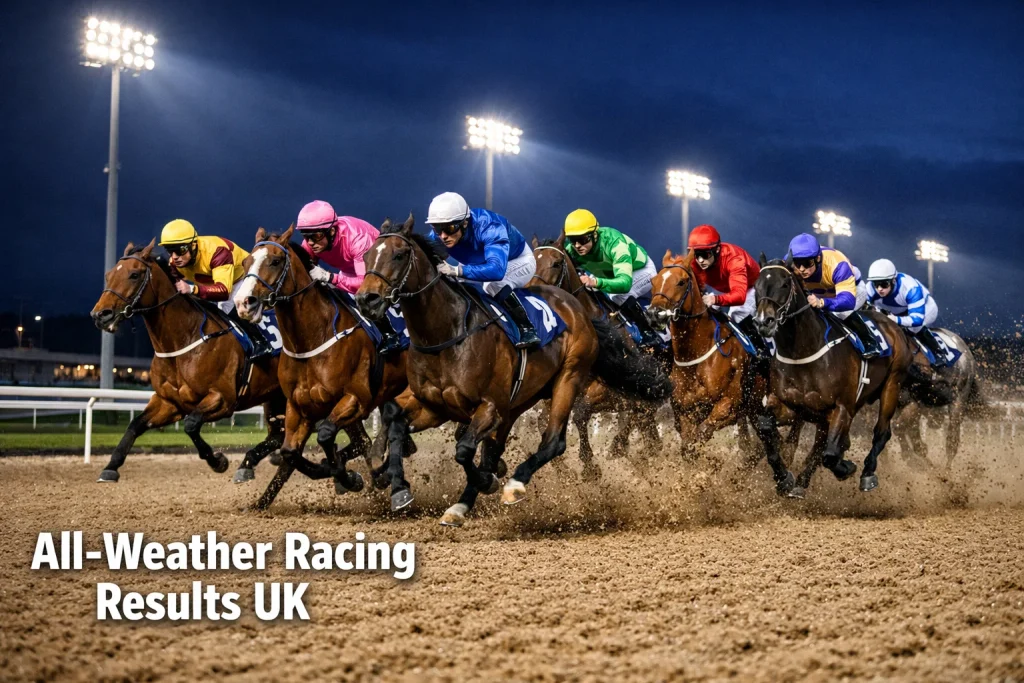
All-weather racing delivers results whatever the weather, providing year-round flat racing that continues when frost, snow, or waterlogging closes turf tracks. These synthetic surfaces transformed British racing's winter landscape, creating consistent conditions that produce reliable form and regular betting opportunities. Results from all-weather tracks matter increasingly as the sector expands its profile.
British all-weather racing generated 26,778 flat runs in the first half of 2024 alone, demonstrating the volume of racing these tracks now provide. Across 1,410 annual British fixtures, all-weather meetings fill the calendar gaps that weather once left empty. Results from these fixtures reward punters who understand synthetic surface racing's particular characteristics.
Racing whatever the weather means exactly that—all-weather tracks rarely abandon meetings for conditions that close turf courses. This reliability makes fixture planning predictable and ensures betting opportunities continue through winter months when turf racing contracts to weekend-only meetings at hardy venues.
The Purpose of All-Weather Racing and UK AW Track Results
Winter racing continuity drove all-weather development. Before synthetic surfaces arrived, British flat racing virtually disappeared from November through March. Turf courses couldn't race on frozen or waterlogged ground, leaving punters with only jump racing through winter. All-weather tracks filled this void, extending flat racing year-round.
Evening racing became feasible under floodlights at all-weather venues. Results from evening meetings draw audiences who work during afternoon racing, expanding racing's reach beyond traditional demographics. The midweek evening fixture has become a staple of all-weather racing, producing consistent betting opportunities outside conventional racing hours.
Prize money development attracted better horses to all-weather racing over time. What began as modest midwinter gambling medium has evolved into a competitive racing programme with significant prizes. Results from the All-Weather Championships Finals Day now matter beyond all-weather specialists, drawing horses who compete across surfaces.
Form reliability makes all-weather results particularly useful for punters. Consistent surfaces produce consistent form—horses who perform well on all-weather tend to repeat that form more reliably than turf horses battling variable going. This predictability rewards systematic analysis of all-weather results.
Surface Types: Polytrack, Tapeta, and Fibresand
Polytrack covers tracks at Kempton, Lingfield, and Chelmsford. This surface combines silica sand, synthetic fibres, and recycled materials to create a consistent racing surface that drains effectively and rarely freezes. Results on Polytrack favour horses who handle the slightly slower pace compared to turf, rewarding tactical speed without demanding extreme acceleration.
Tapeta surfaces Newcastle and Wolverhampton. This newer technology produces faster times than Polytrack, behaving somewhat more like quick turf. Results from Tapeta tracks sometimes translate to turf form more directly than Polytrack results, though surface specialists still emerge who perform better on Tapeta than on natural grass.
Fibresand at Southwell represents the oldest surviving all-weather surface type in Britain. The deep, demanding track produces unique results that rarely translate to other surfaces. Horses win repeatedly at Southwell while failing elsewhere; others struggle with Fibresand's particular demands despite success on alternative surfaces.
Surface preferences matter enormously in all-weather form analysis. Results showing a horse winning at Kempton provide limited guidance for Newcastle assessment—the surfaces behave differently enough that form may not transfer. Studying results by surface type rather than treating all-weather as a single category improves analytical accuracy.
Track configurations compound surface differences. Chelmsford's unique shape differs from Wolverhampton's tight turns; Lingfield's configuration differs from Newcastle's galloping track. Results reflect both surface and track layout, meaning all-weather form analysis requires venue-specific understanding.
British All-Weather Tracks
Lingfield stages both flat all-weather and turf racing, with the all-weather track providing winter continuity. Results from Lingfield's Polytrack tend toward competitive handicaps where field sizes remain healthy. The Derby Trial on turf highlights the venue's dual character, though all-weather results dominate the fixture list numerically.
Wolverhampton operates as an all-weather specialist, staging evening fixtures under floodlights throughout the year. Results from this Tapeta track feature regular performers who reappear frequently, building form profiles that reward punters who follow Wolverhampton racing consistently.
Newcastle's Tapeta surface hosts competitive racing that attracts runners from across northern England and Scotland. Results from Newcastle sometimes reveal northern trainers' all-weather specialists who may not have been tested at southern venues. The track's configuration suits galloping types more than some tighter all-weather circuits.
Chelmsford City represents Britain's newest all-weather track, opened in 2015. Results from this Essex venue feature horses drawn from London's surrounding training centres, with competitive evening cards that attract decent prize money. The unique track layout—a distinctive curve—produces form that requires specific interpretation.
Southwell's Fibresand surface creates an all-weather outlier. Results from Southwell identify horses who act on deep, demanding ground that bears no resemblance to other synthetic surfaces. Some horses win repeatedly here while failing everywhere else; Southwell specialists deserve respect when conditions suit.
Year-Round Racing Programme
Winter months see all-weather dominate British flat racing. Results from November through March come predominantly from synthetic surfaces when turf racing restricts to minimal fixtures at the hardiest courses. This period produces the highest concentration of all-weather results, making winter form particularly significant.
Evening meetings fill the fixture calendar throughout the year. Results from floodlit racing provide midweek betting opportunities that turf racing's afternoon emphasis doesn't offer. The convenience of evening racing times attracts different audiences, including those who follow results after traditional working hours.
The All-Weather Championships provide the programme's competitive apex. Results from championship qualifying races throughout winter determine Finals Day participants. The Finals themselves in spring produce definitive results that identify the season's best all-weather performers.
Summer all-weather racing continues despite turf competition, providing alternative opportunities when turf fields fragment across many fixtures. Results from summer all-weather meetings sometimes reveal horses avoiding strong turf opposition, information worth noting when assessing why connections chose synthetic over grass.
Interpreting All-Weather Form
Surface specialist identification represents form analysis's first priority. Results patterns revealing consistent all-weather success alongside turf failures identify horses who require synthetic surfaces to produce their best. These specialists offer value when returning to all-weather after unsuccessful turf campaigns.
Draw biases vary by track and distance. Results from Wolverhampton sprints show low draws advantaged; other track-distance combinations favour different starting positions. Studying results with draw analysis reveals biases that affect betting assessments.
All-weather form sometimes transfers to quick turf more readily than soft-ground racing might. Results showing horses winning on all-weather who subsequently contest summer flat racing on fast ground sometimes maintain form better than those transitioning to softer winter turf. The surface similarity helps form translation.
Class levels on all-weather differ from turf racing hierarchies. Results from all-weather racing may overstate or understate horses' abilities relative to turf form. Understanding how all-weather class relates to turf class prevents misinterpreting results when horses switch surfaces.
Frequent runners build extensive all-weather form records. Results from horses who run regularly on synthetic surfaces provide larger sample sizes for analysis than horses who appear occasionally. This data density makes all-weather form analysis particularly robust for regular participants.
Weight and class interaction works differently on all-weather. Results suggest that class tells more consistently on synthetic surfaces where going variables don't intervene. Better horses beat worse horses more reliably than on turf where conditions can level fields. This predictability rewards punters who identify genuine class advantages.
Trainer patterns on all-weather repay study. Some yards specialise in all-weather racing, running horses frequently and successfully on synthetic surfaces. Others use all-weather opportunistically, targeting weak races for horses unsuited to turf. Recognising which approach each trainer takes helps interpret results from their runners.
The all-weather programme continues expanding, with new fixtures and increased prize money raising the sector's profile. Results from all-weather racing increasingly feature in discussions of British racing's overall health. Understanding this growing segment positions punters to benefit as all-weather racing claims larger portions of the overall programme.
