
Live Horse Racing Results: Real-Time Updates
 Available in US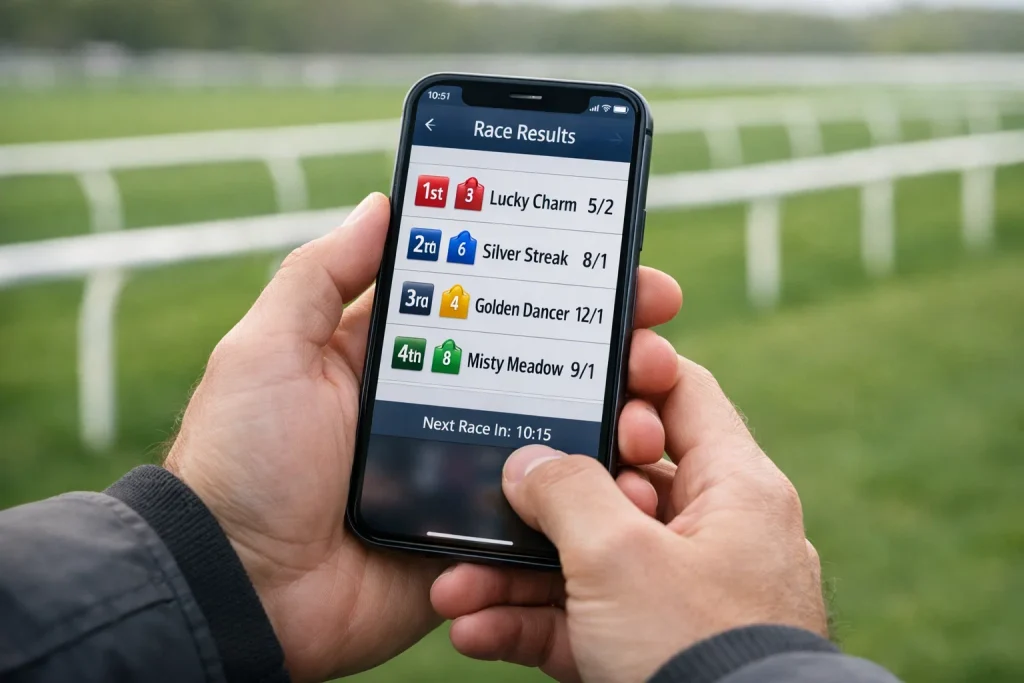
Live horse racing results matter because timing matters. The gap between a race finishing and you knowing the outcome can mean the difference between catching a price or missing it, adjusting your approach for the next race or flying blind, settling a bet in your mind or waiting anxiously. In an era where information travels at digital speed, expecting anything less than real-time racing results feels anachronistic.
The infrastructure behind live results has evolved dramatically. What once required telephoned reports from course representatives now flows through integrated timing systems, photo-finish technology, and data feeds that distribute results within seconds of horses crossing the line. The British Horseracing Authority oversees this ecosystem, ensuring accuracy and consistency across every racecourse.
For punters, the practical implications are significant. Real-time results enable in-play betting strategies that previous generations could not have imagined. They allow rapid response to ground condition changes affecting later races. They support the multi-meeting approach that many successful bettors employ—following several courses simultaneously and reacting to results as they arrive.
The evolution has been rapid. Twenty years ago, results relied on teletext updates and betting shop displays. Ten years ago, websites offered refresh-based results with noticeable delays. Today, push notifications arrive within seconds of races finishing, and in-play betting markets settle almost instantaneously. Each technological step has raised expectations for the next, creating an environment where seconds matter and delays frustrate.
Understanding how live results work helps you use them better. Knowing what might delay updates prevents unnecessary frustration. Recognising the difference between provisional and official results saves premature celebration or disappointment. This guide covers the mechanics, the technology, and the practical applications that make real-time racing results valuable rather than merely convenient.
How Live UK Horse Racing Results and Real-Time Updates Work
The journey from finish line to your screen involves multiple systems working in concert. When horses cross the line, photo-finish cameras capture the moment at approximately 2,000 frames per second. Timing systems record official completion times. Course judges determine the order of finish, and this information feeds into centralised databases that distribute results to licensed providers.
The scale of this operation is substantial. The Racecourse Association confirmed 1,410 fixtures completed in 2024 across British racecourses. Each fixture produces multiple race results—typically six to eight per meeting. That translates to roughly 10,000 race results annually, each requiring accurate capture and rapid distribution.
Brant Dunshea, CEO of the British Horseracing Authority, outlined the broader infrastructure context: "The past year has seen growth in racecourse attendances, the success of the Axe The Racing Tax campaign, major initiatives to ensure more horses are raced and retained on our shores and continued improvements in horse and human welfare." This investment extends to the technical systems that power live results—modern British racing treats data infrastructure as seriously as track maintenance.
Results flow through a hierarchy. The official result exists at course level first, determined by the judge and confirmed by stewards. This feeds to the BHA's central systems, which validate and distribute the data. Licensed data providers receive feeds that power bookmaker results pages, racing websites, and mobile applications. Each step adds minimal latency, but the chain must complete before results reach end users.
The photo-finish plays a crucial role in close results. When multiple horses are separated by small margins, the official result waits for photo analysis. This delay—typically seconds to a minute—ensures accuracy over speed. Users tracking live results learn to recognise the gap between "race finished" and "official result" when finishes are tight.
Starting prices form part of the result package. SP calculation happens rapidly after the race concludes, based on prices offered by on-course bookmakers at the moment the race began. This information accompanies finishing positions in official result data, though some providers display positions before prices are confirmed.
The complete result package extends beyond positions and prices. Winning distances show margins between finishers. Race times establish how quickly conditions allowed racing. Weight carried and jockey identity complete the betting-relevant data. All this information flows through the same channels that deliver basic finishing orders, though some providers display comprehensive data while others show simplified summaries.
Seasonal and daily patterns affect result flow volumes. Busy Saturday afternoons with multiple meetings generate results in rapid succession. Quiet Monday evenings with single-course fixtures produce results sporadically. Understanding these rhythms helps calibrate expectations—constant result flow on peak days, intermittent updates during quieter periods. The infrastructure handles both scenarios, scaling throughput to match racing volumes.
Speed of Updates: What Affects Timing
Several factors determine how quickly results reach you after a race finishes. Understanding these helps set realistic expectations and identify when delays indicate genuine issues rather than normal processing.
Race clashes historically caused significant delays. When multiple meetings staged races simultaneously, processing bottlenecks slowed distribution. The BHA Racing Report 2024 showed major progress: Saturday clashes before 5pm fell from 11.1% in 2022 to just 5.8% in 2024. This scheduling improvement means fewer simultaneous races competing for processing resources and faster results reaching users.
Photo-finish requirements add variable delays. A five-length winning margin needs no photo analysis—the judge calls the result immediately. A short-head victory might require careful frame-by-frame examination. Most photo finishes resolve within sixty seconds, but particularly close or complex results occasionally take longer. The wait is worth the accuracy.
Stewards' enquiry announcements create longer delays. When the enquiry flag appears, the official result remains provisional pending investigation. Quick enquiries—obvious interference, straightforward decisions—might resolve in two to three minutes. Complex cases involving multiple horses or reviewing extended sections of the race can take considerably longer. During enquiries, provisional results show what happened on the track; official results wait for the stewards' verdict.
Technical infrastructure affects speed invisibly. Well-maintained systems at major courses process results faster than stressed equipment at smaller tracks. Network connectivity varies by location. While these differences rarely exceed seconds, they accumulate when following multiple simultaneous meetings. Professional punters sometimes notice that results from certain courses consistently arrive marginally quicker than others.
Your own access method matters too. Dedicated racing apps with direct data feeds typically display results faster than browser-based services refreshing periodically. Betting exchange interfaces often show results quickly because their in-play markets require real-time data. Social media results depend on whoever posts first—sometimes rapid, sometimes unreliable.
The gap between "live" and "instantaneous" deserves recognition. No result appears truly instantaneously—photo analysis, data entry, transmission, and display all take time. What matters is that modern systems compress these steps sufficiently that results feel real-time. A five-second delay after the finish poses no practical problems for most users.
Peak racing periods stress the system most. Saturday afternoons with multiple Premier meetings running simultaneously create the highest demand. Bank holiday fixtures, festival days, and major events all generate elevated traffic. During these periods, results may arrive marginally slower than during quiet Tuesday afternoons—the infrastructure handles volume competently but not infinitely.
International results follow different timelines. Irish racing results typically arrive through British systems with minimal additional delay. French and other European results take longer, flowing through separate infrastructure before reaching British providers. American results operate on entirely different schedules. Punters following international racing should adjust expectations accordingly.
Official Sources and Data Reliability
Not all results sources offer equal reliability. Understanding the hierarchy helps you prioritise accurate information over merely fast information when the two conflict.
The British Horseracing Authority maintains definitive records. Their data represents the official version of every result from British racing. According to the BHA Horse Population Report, 13,751 individual runners competed year-to-date in 2024—each generating result data that flows through official channels. The BHA's systems feed licensed providers who distribute to end users.
Racecourse websites provide authoritative local data. Major tracks display results directly from their timing systems. These pages occasionally show results marginally before aggregated services, though the advantage rarely exceeds seconds. Course websites also provide detailed information sometimes absent from third-party providers: official going updates, non-runner announcements, and stewards' reports.
Licensed data providers power most consumer-facing results services. Companies like the Press Association, Timeform, and Racing Post receive official feeds and distribute processed data to bookmakers, websites, and applications. Their licensing ensures accuracy while adding value through formatting, historical context, and analytical overlays.
Bookmaker results pages offer convenience with potential compromises. Betting operators need results quickly to settle bets, so they invest in rapid data integration. However, their primary interest is settling markets, not serving racing enthusiasts. Some operators display simplified results lacking details that dedicated racing services include.
Betting exchange results merit separate consideration. Betfair and other exchanges display results rapidly because their in-play markets require them. Exchange results sometimes appear before traditional bookmaker updates, making exchanges useful monitoring tools even for punters who prefer fixed-odds betting.
Social media offers speed without guarantees. Twitter accounts and Facebook groups sometimes post results fastest, particularly from course attendees with visual confirmation. But social media lacks quality control—incorrect results occasionally circulate before correction. Use social media for early indications while awaiting official confirmation.
Television broadcasts provide visual confirmation that data feeds cannot match. Watching ITV Racing or Racing TV means seeing races conclude in real-time. For punters who follow specific meetings closely, broadcast coverage offers irreplaceable context around results—how horses travelled, where jockeys positioned, what the finish looked like in motion.
The reliability hierarchy therefore runs: BHA official records as definitive truth, course websites for local detail, licensed providers for processed data, bookmakers for betting-relevant information, exchanges for speed, social media for early indications, and broadcasts for visual context. Each source serves different needs; combining them appropriately creates complete coverage.
Historical results present different reliability considerations. Archives maintained by official sources—BHA, Racing Post, Weatherbys—offer accurate historical records. Third-party databases sometimes contain errors, particularly for older results predating digital systems. When researching historical form, prioritise authoritative sources over aggregated databases of uncertain provenance.
Mobile Access: Results on the Go
Mobile devices have transformed how punters consume racing results. The shift toward smartphone-based betting means results increasingly arrive on the same devices used for placing bets, creating seamless workflows that desktop-era punters could not achieve.
The Gambling Commission reported that over 70% of online gambling occurs on mobile devices. Racing results consumption follows this pattern—most punters checking outcomes do so on phones rather than computers. Results services have adapted accordingly, prioritising mobile interfaces and app development.
Dedicated racing apps offer the most integrated experience. Applications from the Racing Post, At The Races, and major bookmakers combine live results with related functionality: form guides, betting markets, video replays, and push notifications. These apps justify their smartphone real estate by serving as comprehensive racing companions.
Mobile browser access provides flexibility without installation. Racing websites optimised for mobile displays deliver results adequately for occasional users. The experience typically lacks the polish of dedicated apps but works across devices without app store dependencies. Browser-based access suits punters who follow racing sporadically rather than intensively.
Push notifications represent mobile's distinctive advantage. Configured properly, your phone alerts you to results without requiring active monitoring. This passive approach suits punters who bet earlier in the day and want updates without constant screen-checking. Notification settings typically allow filtering by course, race type, or specific horses—avoiding notification overload while ensuring important results arrive promptly.
Battery and connectivity matter for serious mobile use. Following a full afternoon of racing drains battery significantly. Data requirements are modest—results are text-based—but continuous refreshing accumulates. Punters relying on mobile results should plan accordingly: charged devices, reliable connections, possibly backup options if primary phones fail.
Racecourse Wi-Fi supports on-site mobile use, though quality varies. Major tracks generally provide adequate coverage; smaller courses sometimes struggle with capacity on busy days. The irony of attending racing but relying on mobile results exists—but when betting requires real-time information from other meetings, even racegoers need mobile connectivity.
Smartwatches extend mobile results to wrists. Some racing apps offer watch companions displaying basic results and notifications. The format suits quick glances—winning horse, SP, maybe a margin—rather than detailed analysis. Watch-based results work best as alerting mechanisms triggering deeper investigation on phone or tablet.
Tablet devices occupy middle ground between phones and computers. Larger screens display more information simultaneously, making tablets useful for following multiple meetings. The portability suits punters who want serious analysis without being desk-bound. Some dedicated racing enthusiasts use tablets specifically for results tracking while phones handle betting transactions.
Screen size affects usability significantly. Phones excel at quick result checks—winner, SP, perhaps margins. Detailed result analysis—full field finishing positions, sectional times, in-running market movements—benefits from larger displays. Matching device choice to use case improves efficiency. Quick confirmations suit phones; deep analysis suits tablets or computers.
Setting Up Notifications
Effective notification configuration balances completeness against distraction. Too few notifications and you miss important results. Too many and notification fatigue sets in, causing you to ignore alerts that actually matter.
Start by identifying which results genuinely require immediate attention. Horses you have backed obviously qualify. Horses you are following for future betting might warrant alerts. Results from meetings you are monitoring actively need coverage. But every race from every meeting? That volume overwhelms rather than informs.
Most racing apps offer tiered notification settings. Basic configurations alert to any result from selected meetings. Intermediate settings allow specifying race types—Group races only, handicaps only, specific distance ranges. Advanced configurations support alerts for individual horses across all their races, trainer-specific updates, or jockey-following.
Bookmaker apps typically integrate betting-related notifications with results. Back a horse and you will receive its result automatically. This passive approach requires no configuration beyond placing bets. The limitation: you only get results for horses you have backed, missing broader meeting context.
Third-party notification services offer additional flexibility. Some punters use IFTTT or similar automation tools to create custom alerts based on results feeds. These technical solutions suit users comfortable with configuration who want specific behaviours unavailable in standard apps.
Test your notification setup before relying on it. Place a small bet, confirm the result notification arrives appropriately. Follow a meeting you can also monitor directly, checking that alerts arrive when expected. Better to discover configuration problems during testing than during important betting sessions.
Consider notification timing preferences. Some users want instant alerts regardless of context. Others prefer silent hours during work or sleep, with results accumulated for later review. Most apps support scheduling—immediate notifications during racing hours, silent overnight, summarised morning updates for yesterday's late racing.
Redundancy provides security for important results. If one notification channel fails—app crashes, phone dies, connectivity drops—backup options matter. Punters with significant positions sometimes configure multiple alert sources ensuring at least one reaches them regardless of individual system failures.
Managing notification volume becomes important during busy racing periods. Festival weeks like Cheltenham or Royal Ascot generate result notifications continuously. Without filtering, your phone buzzes constantly—useful perhaps, but potentially overwhelming. Strategic muting of less important meetings while maintaining alerts for priority races balances completeness against sanity. The goal is receiving the notifications you need without drowning in those you do not.
Reviewing notification performance periodically improves your setup. After busy racing days, consider which alerts proved valuable and which created noise. Adjust settings accordingly. Over time, this refinement produces a notification configuration precisely calibrated to your betting style and information needs. The investment in configuration pays dividends through racing seasons of reliable, relevant result alerts.
When Results Are Delayed
Delayed results frustrate punters but usually have explainable causes. Understanding common delay reasons helps distinguish normal processing from genuine problems requiring attention.
Stewards' enquiries create the most common significant delays. When the enquiry announcement appears, official results wait for the stewards' decision. Enquiries into interference typically resolve within minutes. Complex cases involving objections, multiple incidents, or review of extended race sections take longer. During enquiries, provisional results showing the past-the-post order remain available—just not confirmed.
Photo-finish analysis adds smaller but noticeable delays for close races. Most photos resolve within sixty seconds. Exceptionally tight finishes—dead heats or margins requiring careful measurement—occasionally require additional time. The delay ensures correct placings rather than rushed errors.
Technical issues at courses occasionally disrupt result transmission. System failures, connectivity problems, or equipment malfunctions can delay results from specific meetings. These problems typically affect single venues rather than all racing, so results from other meetings continue normally. Course technical issues usually resolve within races as staff address problems.
Abandoned or void races create different delay patterns. Weather-related abandonments stop results from that meeting entirely. Void races—declared invalid due to starting problems or other issues—require official processing before results status becomes clear. The absence of results differs from delayed results; understanding the distinction prevents unnecessary waiting.
Your own technical problems sometimes masquerade as result delays. App crashes, poor connectivity, or expired sessions can prevent results reaching you while others receive them normally. If a single source shows no results while others work, the problem likely sits locally rather than with racing infrastructure.
Cross-referencing solves most delay puzzles. Check multiple sources when results seem delayed. If the Racing Post, bookmaker apps, and social media all show the same delay, the issue sits upstream—probably a stewards' enquiry or technical problem at the course. If only one source shows delays while others display results, that source has the problem.
Patience generally pays off. Most apparent delays resolve within minutes. Rushing to alternative sources or refreshing obsessively rarely helps and sometimes causes confusion when partial information proves inaccurate. Wait for official results rather than acting on preliminary reports, particularly when betting decisions depend on the outcome.
When delays extend beyond normal ranges, systematic troubleshooting helps. First verify the race actually ran by checking official meeting status. Second, look for stewards enquiry flags on results pages. Third, test alternative sources to identify whether the delay is universal or local to your connection. Fourth, consider that abandoned meetings produce no results at all—sometimes absence of results reflects cancellation rather than technical failure.
Historical context helps calibrate expectations. Modern result distribution is remarkably reliable. Serious failures affecting multiple courses simultaneously are extremely rare. Single-venue technical issues occasionally occur but typically resolve quickly. The infrastructure supporting live results represents decades of investment and refinement. While imperfections exist, the system delivers results reliably enough that delays genuinely warrant investigation rather than resignation.
The practical response to delayed results depends on your situation. If you have bet on the race, patience is necessary regardless—the result determines settlement whenever it arrives. If you are using results to inform subsequent betting, consider whether waiting for confirmation outweighs acting on provisional information. For most punters in most situations, brief delays matter less than accuracy. Taking a few extra seconds to confirm results prevents costly errors based on premature assumptions.
Building familiarity with typical delay patterns helps manage expectations. Cheltenham Festival results during peak sessions may arrive marginally slower than a quiet Tuesday at Catterick—more processing volume creates more latency. Grand National day stresses every system simultaneously. Understanding these patterns prevents interpreting normal variations as problems requiring investigation.
Mobile-specific delays sometimes compound general issues. If your device struggles with connectivity at a busy racecourse or your app requires an update you have not installed, local problems overlay any upstream delays. Distinguishing between infrastructure delays and device-specific issues requires checking multiple sources—if others receive results you cannot see, your equipment needs attention rather than the racing systems.
