
Jump Racing Results: Today's National Hunt Outcomes
 Available in US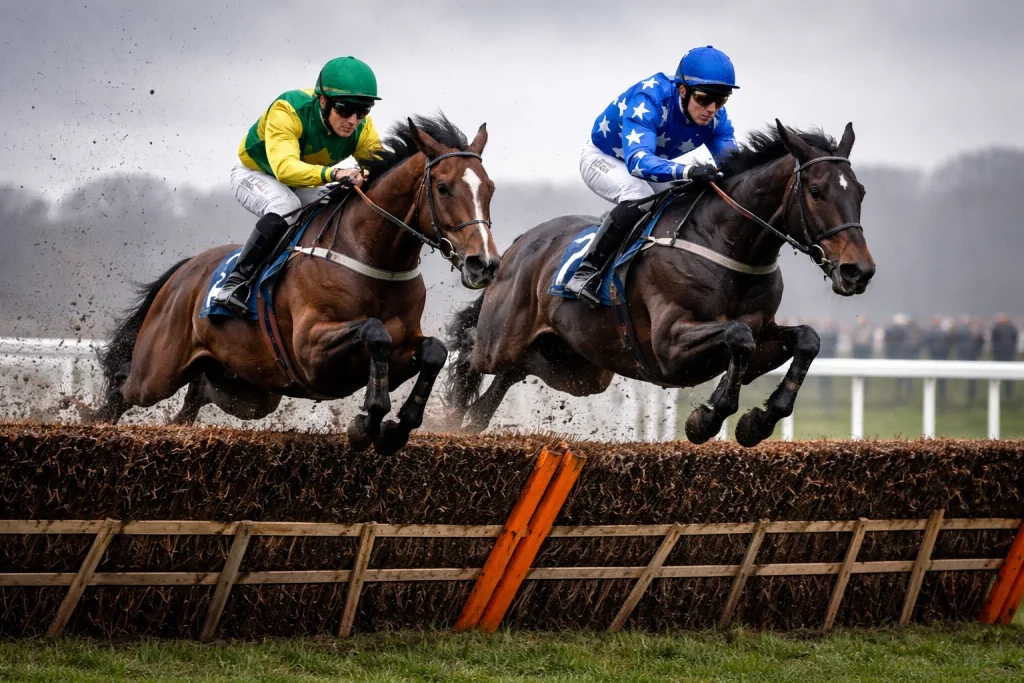
Jump racing results tell stories that flat racing cannot match. Where flat results measure pure speed and acceleration, National Hunt outcomes reveal courage, jumping ability, and stamina over demanding distances. The horses who succeed over fences and hurdles earn their victories through repeated tests of nerve—thirty obstacles in a four-mile chase, each one a potential disaster, each one cleared through trust between horse and jockey.
British jump racing dominates the winter months when turf flat racing sleeps. From October through April, results flow daily from courses across Britain where the focus shifts from pure pace to jumping prowess. The sport attracts a devoted following who appreciate its distinct rhythms: the long campaigns building towards festival targets, the familiar names returning season after season, the drama of championship races decided in the final hundred yards.
For punters tracking today's jump racing results, the landscape differs fundamentally from flat racing. Distances stretch beyond anything the flat sees—three miles is routine, four miles not unusual. Ground conditions matter even more, with heavy going transforming races into wars of attrition. The jumping itself creates variables absent from flat racing: a horse can hold every chance until an error at the final fence sends them sprawling.
What makes jump results compelling is their combination of physical challenge and narrative depth. These are horses racing at their peak for multiple seasons rather than retiring young for breeding. Results build careers that span years, allowing punters to develop genuine knowledge of individuals. The horse who disappointed as a novice hurdler might emerge as a Gold Cup contender three years later. Jump results reward patience and long-term thinking in ways that flat racing's rapid turnover cannot replicate.
The courses themselves shape jump results distinctively. Cheltenham's undulating track tests different qualities from Kempton's flat galloping circuit. Aintree's unique fences create specialists. Sandown's uphill finish exposes non-stayers. Each venue produces results that must be interpreted through the lens of its specific demands. A horse who excels at one course may struggle at another despite facing similar opposition—understanding these track biases separates successful punters from casual observers.
Understanding National Hunt Jump Racing Results in Britain
National Hunt racing—the formal term for British jump racing—accounts for roughly 35% of all races staged in Britain, according to research published in the Equine Veterinary Journal. That proportion has remained stable over decades, reflecting the sport's enduring appeal despite challenges facing the broader racing industry. Jump racing operates as a distinct discipline with its own champions, courses, and traditions rather than simply filling gaps in the flat calendar.
The population of jump horses in training tells a story of growth. The BHA Horse Population Report recorded 3,482 horses in jump training as of June 2024—a remarkable 14.6% increase compared to pre-pandemic 2019. While flat horse numbers have declined, jump racing has expanded its talent pool. That growth manifests in competitive fields and fresh runners entering the ranks alongside established performers.
The year-to-date 2024 statistics showed 16,114 jump runs, representing a 4.1% decline from 2023. That drop reflects deliberate fixture scheduling changes rather than falling interest—the BHA actively consolidated the fixture list to improve field sizes and reduce race clashes. Fewer races with fuller fields produces better quality results for punters to analyse.
Jump horses follow different career arcs than their flat counterparts. Most begin by racing over hurdles as four or five-year-olds, having either failed on the flat or been bred specifically for jumping. The best hurdlers eventually progress to chasing, though some remain hurdling specialists throughout their careers. This progression means jump results often feature the same horses over several seasons, building form profiles that span years rather than months.
Two fundamental disciplines comprise jump racing. Hurdle races feature smaller obstacles—at least 3 feet 6 inches high—that horses jump at speed with a low, flat trajectory. Chase races use larger fences—minimum 4 feet 6 inches—that demand more athletic jumping and greater precision. Results from each discipline require different analytical approaches, though form frequently crosses between them as horses develop.
Distance categories in jump racing extend far beyond flat norms. Hurdle races typically range from two miles to three miles. Chases start at around two miles but stretch to four miles and beyond for marathon events like the Grand National. Staying power becomes paramount at the longest distances. A horse who handles two miles might find three miles beyond them; a three-mile specialist might lack the speed for shorter trips. Results must be read with distance firmly in mind.
Chase Results: Racing Over Fences
Steeplechase results carry a weight that hurdle results cannot match. Fences stand taller, drop deeper on the landing side, and punish errors ruthlessly. A horse clearing twenty-four fences over three miles and winning demonstrates not just speed and stamina but consistent accuracy under pressure. Chase results represent jump racing's ultimate examination.
The standard chase fence measures 4 feet 6 inches in height with a birch construction that gives way on impact while still demanding respect. Open ditches—fences with a ditch on the take-off side—add complexity. Water jumps test technique over broader obstacles. The variety of fence types means chase results reflect how horses handle different challenges, not simply their basic jumping ability.
Novice chase results attract particular attention from shrewd punters. Horses tackling fences for the first time after hurdling careers represent unknown quantities. Some take to chasing immediately, jumping with confidence and gaining lengths at each fence. Others struggle with the larger obstacles, losing position through hesitancy or finding themselves outpaced by natural jumpers. Early novice chase results can identify future stars before markets adjust.
The grading system for chases mirrors hurdle racing. Grade 1 chases—the Cheltenham Gold Cup, King George VI Chase, Champion Chase—represent the pinnacle. Grade 2 and Grade 3 races below them test Pattern-class chasers. Handicap chases then cover the vast majority of results, from valuable televised handicaps down to everyday events at minor tracks. Understanding where a race sits in this hierarchy helps contextualise results appropriately.
Distance categories in chasing define specialisms. Two-mile chasers need speed and slick, accurate jumping at racing pace. The best cover ground quickly between fences and waste no time in the air. Results at two miles favour horses who combine flat speed with fence fluency. The Champion Chase at Cheltenham crowns the division's best.
Three-mile chases represent the stamina end without reaching marathon distances. The Gold Cup distance tests staying power alongside jumping ability. Most National Hunt horses aspire to this distance range. Results here frequently determine seasonal championship debates. The King George on Boxing Day and Gold Cup in March set the standard.
Staying chases beyond three miles five furlongs enter marathon territory. The Grand National over four miles and two furlongs with thirty unique fences represents the extreme. But regular staying chases at Cheltenham, Haydock, and other courses also test exceptional stamina. Results from staying chases suit older, experienced horses who handle the demands of prolonged effort.
Ground conditions influence chase results dramatically. Soft or heavy ground slows everything down, turning races into stamina tests where jumping errors become more costly—tired horses make mistakes. Good or good to firm ground allows quicker racing where speed matters more than pure endurance. Reading chase results without noting the going misses essential context.
Hurdle Results: The Foundation of Jump Racing
Hurdle racing provides the entry point for most jump racing careers. Results from hurdle races establish whether horses possess the basic aptitude for jumping—the willingness to leave the ground repeatedly, the coordination to land running, the courage to compete while doing so. Horses who fail over hurdles rarely progress to chasing. Those who excel have options.
The hurdle itself measures at least 3 feet 6 inches high, constructed from sections that angle forward. Unlike solid chase fences, hurdles are designed to knock down if struck hard. This forgiving nature allows horses to brush through the top bar without major penalty, though consistently poor jumping still costs ground. Results from hurdle races reward accuracy but tolerate occasional errors.
Juvenile hurdle results attract specific interest. These races, confined to four-year-olds, feature horses experiencing their first jumping campaigns. Many come directly from flat racing, bringing turf form that requires translation. Others were always destined for jumping, bred from National Hunt sires with pedigrees suited to stamina and obstacles. Juvenile hurdle results identify horses with potential before they face older rivals.
The Triumph Hurdle at Cheltenham represents the juvenile championship. Results from this Grade 1 contest often predict future champions—the winner's list includes some of the most celebrated names in jump racing history. Reading juvenile hurdle results throughout the season helps identify potential Triumph Hurdle contenders before markets fully price their claims.
Novice hurdle results feature horses in their first or second season over obstacles, having not yet won certain qualifying races. The novice division produces annual debates about which horses deserve championship favouritism. Results from novice hurdles at Cheltenham, Leopardstown, and other major tracks set the market for the Supreme Novices' Hurdle and Ballymore Novices' Hurdle at the Festival.
Open hurdle results feature experienced hurdlers contesting established races. The Champion Hurdle at Cheltenham crowns the division's best. Results from major trials—the Fighting Fifth, Christmas Hurdle, Irish Champion Hurdle—determine championship pecking orders. Some horses specialise as hurdlers throughout their careers, never tackling fences. Their results build across seasons, creating form profiles punters can trust.
Handicap hurdles dominate the daily results landscape. From valuable fixtures like the Imperial Cup and County Hurdle down to everyday events, handicap hurdles test horses against the BHA assessor's ratings. Results frequently produce surprise winners at big prices—handicap hurdling offers some of National Hunt racing's most open betting heats. The handicapper cannot account for improvement or horses reaching peak fitness at the right moment.
Safety and Welfare in Jump Racing
Beyond form analysis and betting considerations, modern jump racing operates under intense scrutiny regarding horse welfare. The sport's regulators work continuously to minimise inherent risks while maintaining the sporting challenge that defines National Hunt racing. Results data now encompasses not just winners and placings but also falls, unseated riders, and—in tragic cases—fatalities. Understanding these statistics provides essential context for anyone following the sport seriously.
Current data from HorsePWR—the British Horseracing Authority's welfare and performance tracking platform—shows a jump racing fatality rate of 0.47% in 2025, representing 133 fatalities from 28,116 runners. The rate for flat turf racing sits significantly lower at 0.10%, reflecting the additional hazards that obstacles create. These statistics are published transparently, allowing anyone to examine racing's safety record.
The research community actively studies ways to reduce these figures. As authors of a major study published in the Equine Veterinary Journal noted: "Race-related fatality is a major concern for the horseracing industry, with the sport's regulators committed to improving horse welfare and jockey safety by reducing, in as far as possible, any avoidable risk of equine fatality at the racecourse. By taking a proactive approach in addressing this welfare concern, the industry also strives to maintain the sport's social licence to operate."
Since 2000, British racing has invested £56 million in equine health and veterinary research. That investment has produced tangible improvements: fence design modifications, course inspections, veterinary presence requirements, and withdrawal protocols for horses showing signs of distress. Results from modern jump racing reflect a sport that has evolved significantly from historical practices.
Specific fence modifications have addressed historical danger points. The Grand National's infamous Becher's Brook fence has undergone multiple redesigns to reduce the landing side drop. Courses across Britain have replaced rigid rails with flexible alternatives. The BHA maintains detailed records of incidents at specific obstacles, using this data to identify and address problems.
Results data increasingly incorporates welfare metrics alongside finishing positions. The HorsePWR platform tracks not just fatality rates but also fall rates, veterinary inspections, and post-race observations. This granular approach helps identify patterns that aggregate statistics might miss. A course showing elevated fall rates at specific fences faces scrutiny and potential modifications.
For punters, safety data provides analytical angles that pure form misses. A horse who has fallen in recent starts might lack confidence. A jockey known for negative riding—pushing horses at fences beyond their comfort—creates risks that other riders avoid. Results where multiple horses fall suggest ground conditions or course preparation issues that affect future assessments. Welfare data enriches rather than contradicts form analysis.
The Jump Racing Calendar
The National Hunt season follows a rhythm distinct from flat racing's summer-focused pattern. Core jump racing runs from October through April, building towards the Cheltenham Festival in March. Summer jumping continues between May and September at dedicated venues, but with reduced intensity. Results from each phase carry different weight and require adjusted expectations.
October marks the season's proper beginning. Horses return from summer breaks carrying fitness question marks. Early season results often surprise, with horses ahead of their rivals in preparation winning at prices their future form will not replicate. The wise approach to October results is recognising their provisional nature—these performances establish baselines rather than final assessments.
November brings the season's first serious examination. Cheltenham's November meeting provides early Festival clues. Results from the Paddy Power Gold Cup, the first major handicap chase of the season, indicate which horses are thriving. By late November, the picture clarifies. Horses still struggling for form face questions about their campaigns; those winning convincingly attract championship market interest.
December's racing captures public attention through the Christmas period. The King George VI Chase on Boxing Day at Kempton represents the season's second-biggest chase after the Gold Cup. Results from holiday racing attract large audiences, though punters should note that horses racing on consecutive days or during intensive schedules may underperform later in the season. Christmas results are dramatic but must be read with fatigue factors in mind.
January and February build towards March's Festival. Results from key trials—the Trials Days at Cheltenham, the Dublin Racing Festival in Ireland, various Listed and Grade 2 events—shape Festival markets. Shrewd punters monitor these results closely, looking for evidence that market favourites deserve their positions or that outsiders have been underestimated. Trial form doesn't guarantee Festival success, but disappointing trial results demand explanation.
March delivers the Cheltenham Festival across four days—twenty-eight races determining divisional championships. Results here carry weight no other meeting matches. Festival winners earn permanent records in jumping history. Festival disappointments reshape assessments for the following season. The entire calendar builds towards these four March days.
April brings the Grand National meeting at Aintree and then the season's final major events. Results from April races often feature tired horses completing demanding campaigns. Some trainers target late-season prizes; others rest horses for the following year. Reading April results requires accounting for where horses sit in their campaigns—a fresh horse meeting tired rivals has advantages that form figures understate.
Summer jumping from May to September continues at courses like Stratford, Worcester, and Market Rasen. These results suit different types: horses who prefer faster ground, horses who cannot handle the deeper winter going, younger horses gaining experience before tackling serious company. Summer jumping form requires separate handling from core season results—the two competitions overlap but do not directly connect.
Festival Racing and Major Events
Jump racing's major festivals concentrate the sport's best results into intense periods. Understanding what each festival offers helps punters prioritise their attention and interpret results appropriately. These meetings provide the benchmarks against which everyday form is measured.
The Cheltenham Festival in March stands alone. Four days, twenty-eight races, no competition from other British tracks. Results here carry more weight than any other meeting—a Cheltenham Festival winner wears that badge permanently. The meeting features eight Grade 1 races, including the Champion Hurdle, Champion Chase, Stayers' Hurdle, and the Gold Cup that closes proceedings on Friday afternoon.
Cheltenham's unique track challenges horses specifically. The undulating left-hand course rises and falls sharply, with a gruelling uphill finish that exposes non-stayers. Results from Cheltenham favour horses who handle the track's demands—proven course form matters more here than at any other venue. Horses with excellent form elsewhere sometimes disappoint at Cheltenham simply because the track does not suit them.
Aintree's Grand National meeting follows Cheltenham three weeks later. Results here feature horses at different points in their campaigns—some peaked at Cheltenham, others freshened for this meeting. The Grand National itself, run over four miles and two furlongs with thirty unique fences, produces annual drama. Its results are legendary but analytically tricky—the race involves so many variables that systematic form analysis struggles to account for them all.
Beyond the National, Aintree hosts top-level races across its three-day card. The Aintree Hurdle, Mildmay Novices' Chase, and Bowl Chase attract high-class fields. Results from these races often contradict Cheltenham form, as horses who struggled at the Festival bounce back on Aintree's flatter track. Reading Aintree results requires understanding that different courses suit different horses.
Kempton's King George VI Chase on Boxing Day provides the season's other championship chase. Run over three miles on a flat, right-hand track, it produces different results patterns from Cheltenham. Speed specialists excel at Kempton where stamina-oriented stayers might prevail at Cheltenham. The two tracks complement rather than replicate each other; results must be interpreted track by track.
The Christmas period more broadly delivers festival-quality racing across multiple venues. Leopardstown in Ireland hosts its own prestigious meeting. Chepstow's Welsh National, Haydock's Tommy Whittle Chase, and other significant races fill the holiday schedule. Results from Christmas racing shape championship markets heading into the New Year.
Punchestown in late April closes the main season with Ireland's end-of-term festival. Results here sometimes reverse Cheltenham form as Irish horses gain home advantage and tired British raiders struggle after long campaigns. Punchestown results matter for assessing horses' overall seasons rather than predicting future performances—the season essentially ends here before summer jumping begins.
Throughout the season, smaller festivals at Cheltenham in October, November, and January provide staging posts. The Open Meeting, November Meeting, and Trials Day each produce results that inform Festival assessments. Sandown's Tingle Creek meeting in December features top two-mile chasers. Ascot's programme includes valuable handicaps and conditions races. These meetings produce results that serious punters monitor throughout the season.
